
CASE STUDY · H365 SUITE
H365 Suite
I worked on several research tracks across HPB's H365 suite. Here are my two most recent: Special Challenges and Badges.
Pick a track to read its case study
TRACK 01 · SPECIAL CHALLENGES
More Than Just a Goal
Understanding what makes physical activity challenges feel achievable, meaningful and worth participating in.
CLIENT
Health Promotion Board (HPB)
PROJECT
Healthy 365 Special Challenges
MY ROLE
UX Researcher (Supporting Role)
TIMELINE
2026
METHODS
Two rounds of moderated usability testing
The challenge
How do you motivate someone to be more active without making the goal feel overwhelming?
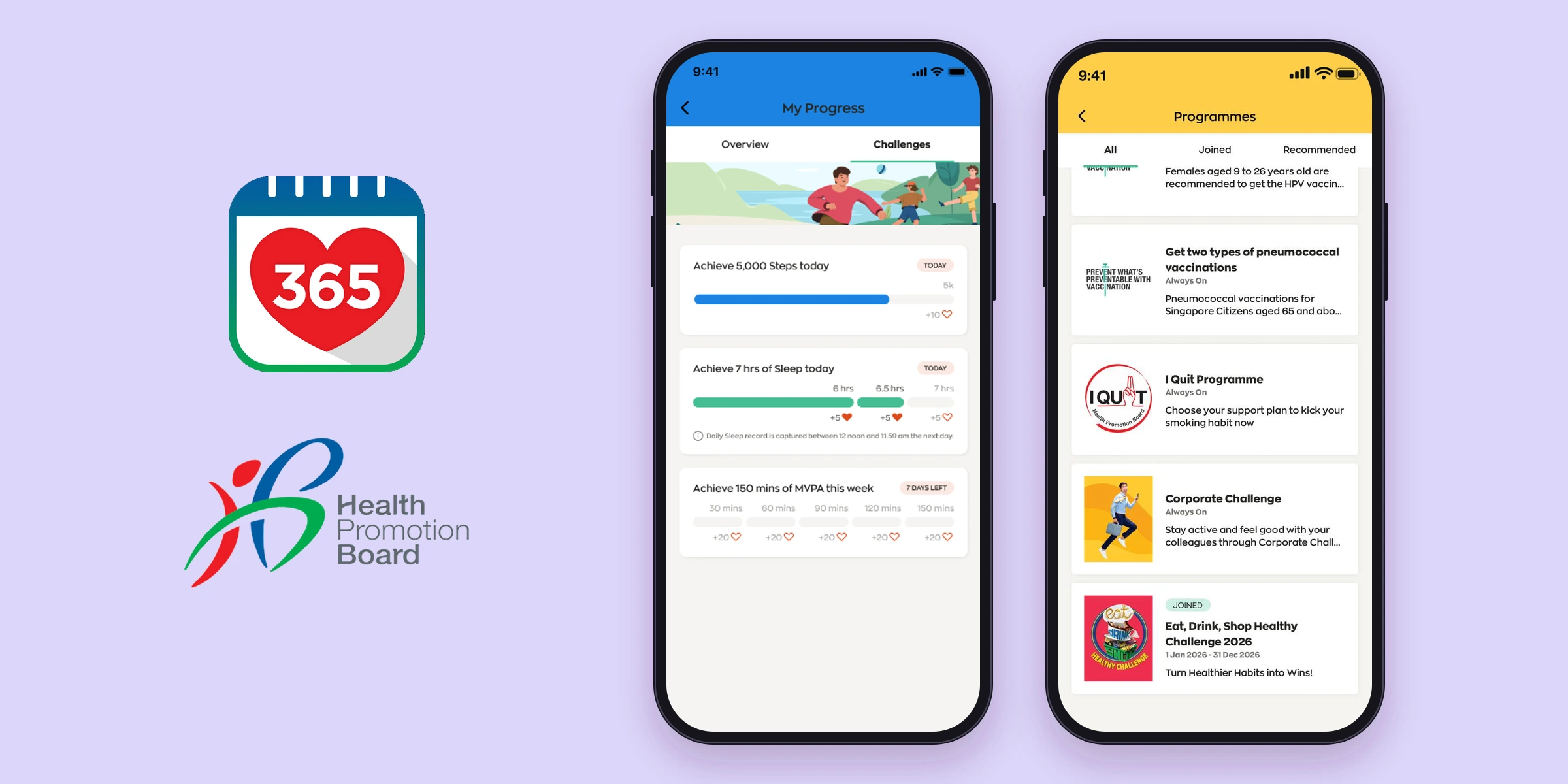
Healthy 365 is a health and wellness app developed by Singapore's Health Promotion Board (HPB), encouraging healthier lifestyles through activity tracking, challenges and rewards. The Special Challenges initiative explored how personalised activity goals could motivate users with lower recorded physical activity levels to become more active.
But setting a goal doesn't necessarily mean someone will feel motivated to achieve it. Our research focused on understanding whether users could discover, comprehend and feel confident participating in these challenges.
THE QUESTION WE HAD TO ANSWER
What makes a challenge feel achievable rather than another target someone might struggle to meet?
What I did
01
Research planning
02
Participant recruitment
03
Notetaking
04
Synthesis
Understanding what motivates people
We needed to look beyond whether participants could navigate the interface.

Our research involved two rounds of moderated usability testing with existing Healthy 365 users. Our research included:
01
Round 1 Usability Testing
Evaluating challenge discoverability, comprehension, motivation and the overall participation journey.
02
Round 2 Usability Testing
Evaluating refined interactions, challenge structures, progress tracking and engagement.
03
Participant Screening & Recruitment
Identifying participants with relevant activity levels and Healthy 365 usage habits.
04
Research Synthesis
Identifying behavioural patterns and usability challenges to inform improvements.
WHERE I CAME IN
I supported research planning, recruitment, moderation and synthesis, including developing the screening questionnaire and discussion guide for the second round.
Beyond usability, I was particularly interested in understanding what made participants want to join a challenge and what might discourage them from following through.
Finding the right people was a challenge of its own
Sometimes, the hardest part of research happens before the first session even begins.
One of my biggest challenges was recruiting participants who genuinely matched our research criteria. We needed Healthy 365 users with lower recorded moderate-to-vigorous physical activity (MVPA) levels. However, some respondents described themselves as inactive despite exercising regularly, while others claimed to track their MVPA without owning a fitness tracker.
I realised that self-reported activity levels weren't enough to determine participant eligibility. To address this, I personally called prospective participants to verify their exercise habits and how they tracked their activity. I also updated our screener to request screenshots of their recorded MVPA.
These additional checks helped us make more informed recruitment decisions, while recognising that recorded activity might not fully reflect someone's actual effort.
WHAT IT TAUGHT ME
It taught me that good recruitment isn't just about filling participant slots. It's about making sure we're speaking to the right people.

Standing up for the demographic questions
A small question in a recruitment survey turned into a decision that shaped who we heard from.
HPB felt demographic questions weren't needed in the recruitment survey for our usability tests. I disagreed and made the case for keeping them, and with my manager's recommendations alongside mine, HPB agreed.
WHY I PUSHED FOR THEM
A usability test only shows us the people in the room. Demographic questions let us check who those people were.
They helped us recruit a deliberately varied group, and gave us the context to read what we observed later. If participants struggled with wording, navigation or motivation cues, we could tell whether that was widespread or limited to certain kinds of users. It also reduced the risk of designing for only a narrow slice of people.
It came up in our second round. Most of the selected participants were university graduates, as fewer non-graduates applied or were suitable. That may reflect barriers to taking part, such as schedule constraints or the effort of completing the survey, and it may also have shaped how people responded. Without the demographic information, we couldn't have noticed this, or asked whether a more varied mix would have told us something different.
WHAT IT TAUGHT ME
It taught me that demographic questions help us see whether our insights are broadly representative or shaped by the people we happened to speak to.
Core discoveries
What usability testing showed about motivation, and what I took from it.
DISCOVERY 01
When the numbers don't tell the whole story
Being less active on paper doesn't necessarily mean being less active in real life.
Interestingly, our recruitment challenges reflected something we later explored during usability testing. Some participants exercised regularly, but their recorded activity didn't always reflect their actual effort. This raised an important question.
AN IMPORTANT QUESTION
If someone's activity data doesn't accurately reflect their effort, how might that affect their motivation to participate?
It made me think more carefully about the relationship between data and the people it represents. A system might use recorded information to personalise an experience, but that doesn't automatically mean it will feel personal or fair to the user.
WHAT I TOOK FROM IT
Personalisation isn't just about using someone's data. It's about making sure the experience feels relevant to their reality.

DISCOVERY 02
Understanding a goal isn't the same as knowing how to achieve it
Sometimes, people don't need more encouragement. They need to understand what they're working towards.
Another interesting area of our research was how participants interpreted activity targets and progress indicators. Even when participants understood that they needed to achieve a goal, they weren't always sure what that meant in practical terms.
THE DISTINCTION
Knowing that you need to increase your activity is different from knowing which activities could help you get there.
This reinforced the importance of asking participants to explain their understanding in their own words, rather than assuming successful navigation meant successful comprehension.
WHAT THIS REINFORCED
Completing a task doesn't always mean understanding it, and understanding a goal doesn't necessarily mean feeling capable of achieving it.
Learning through iteration
The second round of testing wasn't simply about checking whether the design had improved.
Our first round surfaced questions around comprehension, navigation and motivation. For the second round, I helped translate these findings into a more focused research plan and discussion guide. We needed to distinguish between different types of difficulties.
POSSIBILITY 01
Finding it
Was someone struggling because they couldn't find the challenge?
POSSIBILITY 02
Understanding it
Because they misunderstood how it worked?
POSSIBILITY 03
Wanting to do it
Or because they understood it perfectly well but didn't feel motivated to participate?
Each situation suggested a different problem. This influenced how I approached moderation, encouraging me to probe participants' reasoning rather than relying on whether they said something was clear or motivating.
WHAT I LEARNT
Researching motivation isn't about convincing someone that an experience is motivating. It's about understanding what genuinely influences their decisions.

WHEN A DECISION WENT ANOTHER WAY
Research doesn't win every decision. At one point, the client removed a feature that our research had found useful for helping people pace their week.
Looking back
Good research starts long before the first question is asked.
One of my biggest takeaways from Healthy 365 came from the recruitment process. What initially seemed like a straightforward screening exercise taught me to question self-reported information and take additional steps to verify participant eligibility. The usability sessions also challenged me to think beyond whether someone could successfully use an interface.
ONE PARTICIPANT
A participant might understand the experience but feel little motivation to participate.
ANOTHER PARTICIPANT
Another might genuinely want to become more active but feel discouraged when their recorded progress doesn't reflect their effort.
These experiences made me more conscious of how usability, motivation, trust and personal circumstances are connected.
MY BIGGEST LESSON
My biggest lesson was that good research isn't just about asking the right questions. It's also about making sure we're asking them to the right people and understanding the context behind their answers.
TRACK 02 · BADGES
Beyond Collecting Badges
Exploring whether digital achievements can make healthy habits feel more rewarding, and what actually motivates people to keep going.
CLIENT
Health Promotion Board (HPB)
PROJECT
Healthy 365 Badges
MY ROLE
UX Researcher (Supporting Role)
TIMELINE
2025–2026
METHODS
Multiple rounds of moderated usability testing
The challenge
Can a digital badge encourage someone to build healthier habits?
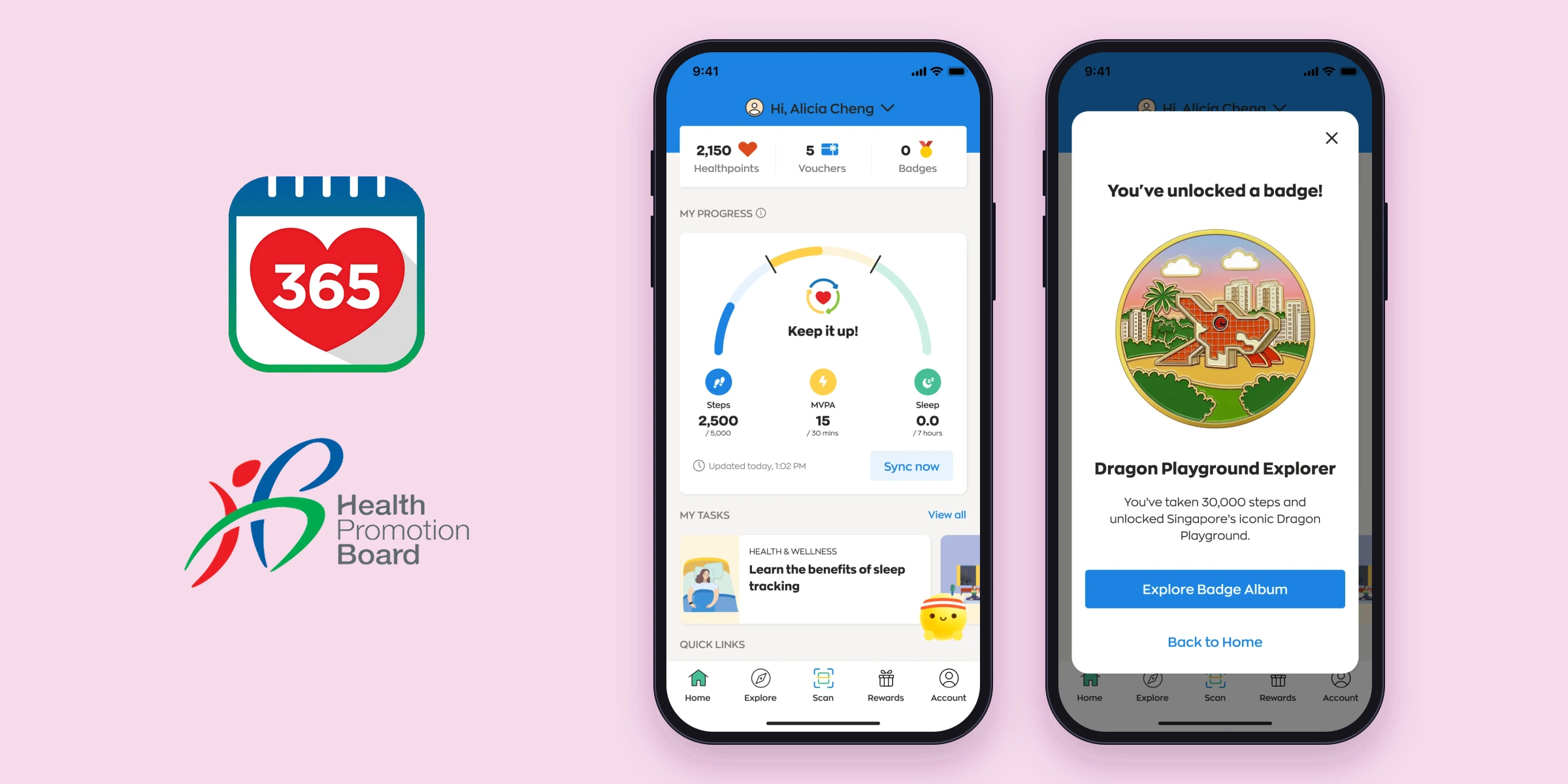
Healthy 365 is a health and wellness app developed by Singapore's Health Promotion Board (HPB), encouraging healthier lifestyles through activity tracking, challenges and rewards. The Badges initiative explored how digital achievements could recognise users' milestones, celebrate their progress and encourage continued participation in healthy activities.
But earning a badge and feeling motivated by one aren't necessarily the same thing.
THE QUESTION WE HAD TO ANSWER
Would people see these badges as meaningful achievements, or simply another collection of icons within the app?
Our research focused on understanding how people discovered, interpreted and responded to the badge experience.
What I did
01
Note-taking
02
Reviewing recordings
03
Evidence analysis
04
Synthesis
Understanding what makes achievements meaningful
We wanted to understand more than whether people liked the badges.

Our research involved multiple rounds of moderated usability testing, progressively evaluating different aspects of the badge experience. Our research included:
01
Iterative Usability Testing
Evaluating how participants discovered, navigated and understood the badge experience.
02
Badge Progression & Comprehension
Understanding how users interpreted achievements, milestones and their progress towards earning badges.
03
Motivation & Engagement
Exploring whether badges encouraged participation, recognition and a sense of accomplishment.
04
Research Synthesis
Analysing participant feedback, behaviours and observations to identify usability issues and opportunities for improvement.
WHERE I CAME IN
I joined the wider research effort in a supporting role, helping document usability sessions, review recordings, analyse participant feedback and contribute to the research findings.
Core discoveries
What the badge research showed about motivation, and what I took from it.
DISCOVERY 01
Recognition isn't necessarily motivation
One of the most interesting questions was whether badges could actually change people's behaviour.
Through testing, we explored how participants responded to digital achievements and what made them feel rewarding. An interesting distinction emerged.
THE DISTINCTION
People could appreciate receiving recognition for their efforts without necessarily feeling motivated to change their habits just to earn another badge.
This made me think about the difference between rewarding existing behaviour and encouraging new behaviour.
WHAT I TOOK FROM IT
Just because someone enjoys receiving a reward doesn't mean that reward is the reason they took action.
For me, this reinforced the importance of looking beyond participants' positive reactions. Someone might describe a feature as enjoyable, but that doesn't necessarily mean it will influence their behaviour in the long term. Understanding that distinction helped us think more critically about the role badges could play in supporting healthier habits.
DISCOVERY 02
When progress isn't clear
An achievement feels less meaningful when you don't understand how you earned it.
Another area we explored was how participants understood badge requirements, progression and the organisation of their achievements. Some participants had difficulty interpreting how badges related to one another or what they needed to do to earn their next achievement. This highlighted something important.
A visually appealing badge might capture someone's attention, but its meaning depends on whether they understand what it represents.
AN IMPORTANT QUESTION
If users can't tell what they've accomplished or what comes next, how can we expect them to feel motivated by their progress?
It reminded me that even playful, gamified experiences need clear information and intuitive navigation.
WHAT THIS REINFORCED
Sometimes, making something more rewarding starts with making it easier to understand.
Finding the story behind the observations
One of my biggest challenges was making sure our insights were genuinely supported by what participants said and did.
As part of my role, I supported usability sessions through detailed note-taking, capturing participant feedback and observing how they interacted with the prototype. But the work didn't end when the sessions finished.
I spent time revisiting recordings, verifying participant statements and examining observations in greater depth. I also independently reviewed the research findings and identified supporting evidence to strengthen the team's synthesis. This required looking beyond what participants said at face value.
POSSIBILITY 01
Unclear information
Was someone confused because the information was unclear?
POSSIBILITY 02
Little personal value
Did they understand the feature but see little personal value in it?
POSSIBILITY 03
An unfamiliar idea
Or were they simply unfamiliar with the concept of digital achievements?
Similar reactions could have very different underlying reasons.
WHAT I LEARNT
I learnt that good synthesis isn't just about identifying patterns. It's about making sure our interpretations are grounded in the evidence.

Learning through iteration
Each round of testing helped the team ask more specific questions.
One of the valuable aspects of this project was seeing how the research evolved across multiple rounds. Earlier testing explored whether participants could discover and understand the badge experience. Subsequent rounds examined how the organisation of badges, progression mechanics and supporting information affected comprehension and motivation.
As the experience became more refined, our research questions also became more specific. We weren't simply asking whether participants liked the badges anymore.
THE QUESTIONS GOT SHARPER
We were exploring whether they understood their achievements, recognised their progress and found enough value in the experience to return.
I supported this process by helping consolidate observations, identify recurring usability difficulties and connect participant feedback to actionable recommendations.
WHAT IT SHOWED ME
It showed me how iterative research builds on earlier discoveries rather than treating every round of testing as a separate exercise.
Looking back
This project taught me to look beyond positive feedback and understand what actually makes an experience meaningful.
One of my biggest takeaways was learning to distinguish between what people enjoy and what genuinely motivates their behaviour.
ENJOYING IT
Someone might appreciate a digital badge without feeling compelled to earn more.
UNDERSTANDING IT
They might find an achievement visually appealing but struggle to understand what it represents.
CLARITY
And sometimes, a small improvement in clarity can be more valuable than introducing another reward.
The project also strengthened my approach to research synthesis. Reviewing recordings, tracing observations back to participant evidence and questioning interpretations taught me to be more deliberate about how I developed findings.
MY BIGGEST LESSON
My biggest lesson was that research isn't just about discovering what people like. It's about understanding why something matters to them, and whether that meaning is strong enough to influence their behaviour.
NEXT PROJECT
The Last Hour